Introduction
Every email your team sends, every video call with a client, every transaction your systems process, every file your employees access — all of it runs on your network. And yet, for most US businesses, the network is the IT asset that receives the least proactive attention. It’s treated as infrastructure: assumed to be there, noticed only when it fails.
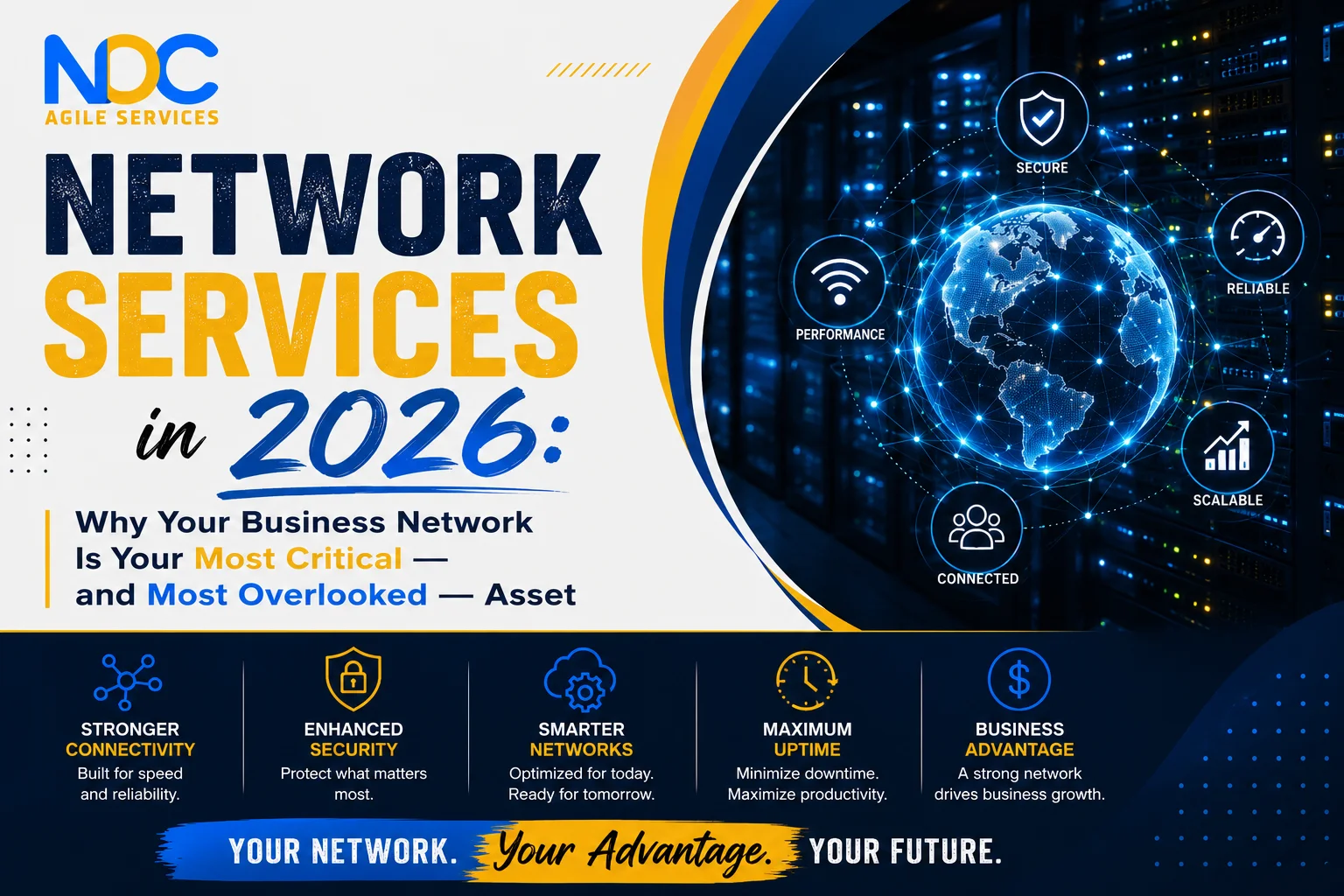
In 2026, that attitude is increasingly expensive. Networks have grown dramatically more complex — SD-WAN fabrics, direct cloud connectivity, remote user tunneling, IoT device proliferation, multi-site redundancy — and that complexity demands a more intentional approach to network services and management. This blog explains what that looks like in practice.
The Modern Business Network Is Not What It Was Five Years Ago
Five years ago, a typical mid-sized US business network looked something like this: a central office with a firewall, a few managed switches, a Wi-Fi access point or two, a server room with physical hardware, and MPLS links to remote sites if they had them. Complex to manage, certainly — but architecturally straightforward.
Today’s network looks completely different. Cloud workloads in AWS, Azure, and Google Cloud have replaced the server room. SD-WAN has replaced MPLS at most sites. Zero-trust network access (ZTNA) architectures are routing remote users through cloud-hosted security stacks rather than VPN tunnels. IoT devices — everything from smart HVAC systems to IP cameras to industrial sensors — are attached to corporate network segments. And security considerations are woven into every layer of the architecture rather than concentrated at a single perimeter.
This architectural evolution is positive — it enables the flexibility, scalability, and resilience that modern businesses need. But it also creates a management challenge that requires a completely different skillset and toolset than traditional network services demanded.
What Comprehensive Network Services Should Cover in 2026
Network Design and Architecture
Everything downstream of a poor network design decision is harder. Good network services start with architecture — ensuring your network is designed to support your application requirements, security policies, and growth plans. In 2026, this means designing for hybrid connectivity (on-premises plus multi-cloud), microsegmentation for security, and redundancy that matches your business’s availability requirements.
LAN and WAN Management
Ongoing management of your physical and logical network infrastructure — switches, routers, firewalls, wireless access points, and WAN links — remains a core network services responsibility. This includes configuration management, firmware maintenance, performance optimization, and capacity planning. Seemingly mundane tasks like VLAN management and QoS configuration have outsized impacts on application performance and user experience.
SD-WAN Management
For businesses with multiple locations, SD-WAN has become the standard WAN connectivity approach — offering better performance, more flexibility, and lower cost than traditional MPLS. But SD-WAN environments require ongoing management: policy tuning, link performance monitoring, failover testing, and integration with cloud security stacks. These are specialized skills that many in-house IT teams lack.
Network Security Integration
In 2026, the network and security layers are inseparable. Next-generation firewalls, intrusion detection and prevention systems, DNS security, and network access control systems all require active management and tuning to remain effective. Your network services provider should either have these capabilities in-house or maintain close integration with your SOC provider — as NOCAgile does through our joint NOC and SOC Services delivery model.
Cloud Connectivity and Direct Connect Management
As workloads move to the cloud, the performance and reliability of your cloud connectivity becomes as important as your LAN. Services like AWS Direct Connect, Azure ExpressRoute, and Google Cloud Interconnect provide dedicated, high-performance paths to cloud environments — but they require careful configuration and ongoing monitoring. This bridges naturally with Cloud Services management to deliver end-to-end connectivity oversight.
The Performance Impact of Poorly Managed Network Services
Network problems are rarely binary — networks don’t just “work” or “not work.” The more common scenario is gradual degradation: latency that creeps up week over week, bandwidth utilization that slowly climbs until it becomes a bottleneck, a misconfigured QoS policy that causes voice traffic to compete with large file transfers during peak hours.
These gradual degradations are often attributed to application issues or user complaints about “the system being slow” — when the root cause is actually a network management gap. This is one of the most powerful arguments for pairing network services with active NOC monitoring: when engineers are continuously watching your network’s performance metrics, degradation trends are caught and corrected before they become user-impacting.
NOCAgile’s Managed NOC Services include network performance monitoring as a core component, with automated alerting on latency thresholds, packet loss rates, bandwidth utilization, and interface error counts — giving your team early warning of developing issues across your entire NOC Services USA coverage scope.
Network Resilience: Building for the Business Continuity Expectation
In 2026, business continuity expectations have shifted. Five years ago, an hour of network downtime was inconvenient. Today, for most US businesses, an hour of network downtime means: customer-facing services unavailable, remote workers locked out of systems, cloud applications unreachable, voice communications down, and potentially cascading impacts on production, fulfillment, or patient care depending on your industry.
This raises the bar for network resilience significantly. Effective resilience planning involves:
Redundant WAN Connectivity
Every primary internet or WAN link should have a failover path with automatic switchover. This is the minimum viable resilience posture for any business-critical site in 2026. The failover path doesn’t need to match primary link performance — but it needs to exist and be tested regularly.
Redundant Core Infrastructure
Core switches, routers, and firewalls at critical sites should be deployed in high-availability configurations where the business impact of a single device failure justifies the cost. For most organizations with significant revenue dependency on IT, this threshold is lower than they think.
Regular Failover Testing
A resilient network design that has never been tested is a hypothesis, not a solution. Scheduled failover testing — where primary links or devices are deliberately taken offline to verify failover behavior — is a practice that distinguishes mature network operations from wishful thinking.
NOCAgile Network Services: Designed for the 2026 Business Reality
At NOCAgile, our Network Services are delivered by certified network engineers with expertise across Cisco, Palo Alto, Fortinet, Meraki, and major cloud networking platforms. We don’t just monitor your network — we manage it: optimizing configurations, planning capacity, coordinating ISP escalations, and continuously hardening your security posture.
Our NOC Services & Managed IT Solutions model means your network never operates in isolation from the rest of your IT environment. Network events are correlated with infrastructure events, security alerts, and application performance data — giving our engineers the full-picture visibility they need to diagnose and resolve issues faster than any siloed approach allows.
The Network Is the Foundation — Treat It Like One
Every layer of your digital business — applications, data, users, security, cloud — depends on your network. Neglecting it is not a cost-saving measure; it’s a hidden investment in future downtime, security incidents, and user frustration. In 2026, professional network services management is not a luxury for large enterprises — it’s a baseline requirement for any business that depends on technology to operate.
If your network is currently managed reactively — addressed when it breaks rather than maintained continuously — now is the right time to change that. Contact the NOCAgile team to learn how our network management and Managed IT Services capabilities can give you the reliable, secure, and high-performing network your business deserves.


