If your network goes down at 2 AM, does anyone notice before your customers do? For most growing businesses, the honest answer is no — and that’s exactly the gap managed NOC services are built to close.
In this guide, we’ll break down what managed NOC services actually involve, how they differ from basic IT support, why more US businesses are outsourcing this function instead of building it in-house, and how to tell if it’s the right move for you.
Tired of network issues catching you off guard? Talk to a NOC specialist today and get a free assessment of your current monitoring gaps — no commitment required.
What Are Managed NOC Services?
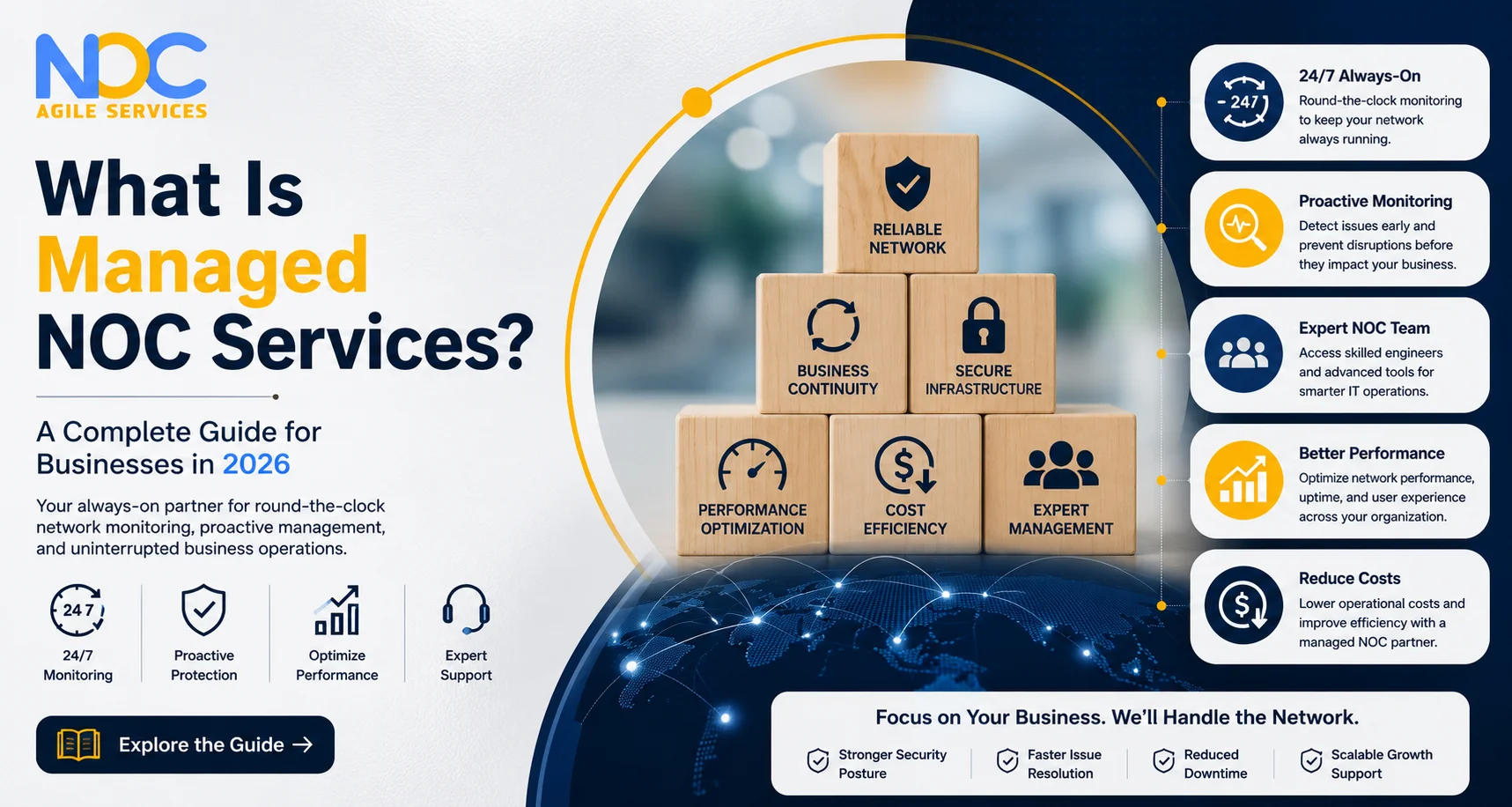
Managed NOC services refer to the outsourcing of your Network Operations Center (NOC) functions to a specialized third-party provider. Instead of hiring, training, and staffing an internal team to monitor your network around the clock, you hand that responsibility to experts who already have the tools, processes, and 24/7 coverage in place.
A managed NOC team typically handles:
- Continuous network monitoring — tracking uptime, performance, and traffic in real time
- Incident detection and response — catching issues before they become outages
- Proactive maintenance — patching, updates, and capacity planning
- Alerting and escalation — making sure the right person knows the moment something breaks
- Reporting and visibility — giving you a clear picture of network health over time
Our own Managed NOC Services page goes deeper into how this is structured for different business sizes, and pairs closely with our broader NOC Services for businesses that want full network operations coverage.
How Managed NOC Services Actually Work, Step by Step
It helps to see the process in motion rather than just a list of features:
- Onboarding and baseline mapping — the provider maps your network, servers, and critical assets to understand what “normal” looks like.
- 24/7 monitoring goes live — automated tools watch performance, uptime, and traffic continuously, with NOC engineers reviewing alerts in real time.
- Issue detection — the moment something deviates from baseline (a spike in latency, a failed device, unusual traffic), it’s flagged automatically.
- Triage and response — engineers assess severity and either resolve it directly or escalate it based on your agreed SLA.
- Resolution and root-cause follow-up — the issue is fixed, documented, and reviewed so the same problem doesn’t repeat.
- Ongoing reporting — you get regular visibility into uptime, incidents, and trends, so monitoring isn’t a black box.
This loop runs continuously, which is exactly why managed NOC services are built around prevention rather than damage control.
How Is This Different from Regular IT Support?
This is the question we get asked most. Regular IT support is usually reactive — something breaks, someone calls, a ticket gets opened. NOC managed services flip that model. The goal is to catch and resolve issues before they ever reach the point of a support ticket, let alone downtime.
Think of it this way: IT support fixes the fire. A managed NOC stops the fire from starting in the first place.
If your team also needs hands-on support for end users — password resets, device issues, day-to-day troubleshooting — that’s a separate but complementary function, which is exactly what our Helpdesk Services cover.
Why Businesses Are Outsourcing Their NOC in 2026
A few trends are driving the shift toward managed NOC services this year:
1. Round-the-clock coverage without round-the-clock hiring costs. Building an internal NOC that runs 24/7/365 means multiple shifts, redundancy, and ongoing training. Outsourcing gives you that coverage at a fraction of the cost.
2. Faster incident response. A dedicated NOC team is solely focused on monitoring — they’re not pulled into other projects when an alert fires.
3. Scalability. As your infrastructure grows — more servers, more locations, more cloud workloads — a managed NOC scales with you without the lag time of hiring more staff.
4. Access to specialized expertise. Network engineers with NOC-specific experience are hard to recruit and retain. A managed provider gives you that bench strength on day one.
5. Better security posture. Most managed NOC providers can also tie monitoring into broader threat detection — which is where it often overlaps with SOC Services for organizations that want both network and security monitoring under one roof.
What Should You Look For in a Managed NOC Provider?
Not all managed NOC services are built the same. Before signing on with a provider, check for:
- True 24/7/365 coverage (not just “extended business hours”)
- Clear SLAs with defined response and resolution times
- Transparent reporting and dashboards you can actually access
- Experience with your specific infrastructure (on-prem, cloud, or hybrid)
- A clear escalation path when something needs human judgment, not just automation
If your infrastructure spans cloud environments too, it’s worth checking whether your provider also offers Cloud Services and Network Services so monitoring isn’t fragmented across multiple vendors. Many businesses also pair NOC monitoring with broader Managed IT Services so infrastructure, devices, and network operations are managed under one strategy instead of separate vendors that don’t talk to each other.
In-House NOC vs. Managed NOC Services: A Quick Comparison
| In-House NOC | Managed NOC Services | |
| Coverage | Limited by shift staffing | True 24/7/365 |
| Setup time | Months to hire and train | Days to weeks |
| Cost structure | Fixed salaries, benefits, tools, training | Predictable monthly cost, scales with need |
| Expertise depth | Limited to who you can hire/retain | Access to a full specialized team |
| Scalability | Slow — tied to headcount | Fast — built into the service |
| Focus | Often split across IT priorities | Dedicated solely to monitoring/response |
For most SMBs and mid-market companies, the cost and speed advantage of going managed is the deciding factor — building an equivalent in-house NOC rarely pencils out below enterprise scale.
Frequently Asked Questions
Does my business need a managed NOC, or is regular IT support enough? If downtime directly affects revenue, customer trust, or compliance, a managed NOC is worth it. If your network is small and simple with low risk of outages, basic IT support may be sufficient for now — but that often changes as you scale.
What’s the difference between NOC services and SOC services? NOC services focus on network performance and uptime — keeping things running. SOC services focus on security — detecting and responding to threats. Many businesses use both together for complete coverage.
How much do managed NOC services cost? Pricing typically depends on the size of your infrastructure, the number of devices/endpoints monitored, and your required SLA response times. Most providers offer tiered, predictable monthly pricing rather than a one-size-fits-all rate — contact us for a tailored quote based on your setup.
Can small businesses benefit from managed NOC services, or is it just for enterprises? Small and mid-sized businesses are actually some of the biggest beneficiaries, since they rarely have the budget to staff a 24/7 internal NOC team but still can’t afford the cost of unplanned downtime.
Is managed NOC the same as managed IT services? No — managed NOC services are a focused subset of managed IT services that specifically cover network monitoring and operations. Managed IT services is the broader umbrella that can also include device management, helpdesk, and infrastructure support.
Is Managed NOC Services Right for Your Business?
If any of the following sound familiar, managed NOC services are likely worth exploring:
- Your internal IT team is stretched thin and reactive rather than proactive
- You’ve had unplanned downtime that hurt revenue or customer trust
- You’re scaling infrastructure faster than you can scale your IT headcount
- You need 24/7 coverage but don’t have the budget for a full in-house shift rotation
Final Thoughts
Managed NOC services aren’t just an IT add-on — they’re becoming a baseline expectation for businesses that can’t afford downtime. Whether you’re a growing SMB or an enterprise managing complex infrastructure, the right managed NOC partner gives you visibility, speed, and peace of mind that an internal team often can’t match cost-effectively.
Stop Reacting to Downtime. Start Preventing It.
NOCAgile’s managed NOC team monitors your network 24/7/365 so issues get caught before they cost you revenue, customers, or uptime.
✅ 24/7/365 monitoring and incident response
✅ Transparent SLAs and reporting
✅ 15+ years of network operations experience
✅ Scales with your business — no long hiring cycles
Get a Free Network Assessment and see exactly where your current setup has gaps — or explore our full range of Services, including NOC, SOC, Cloud, and Helpdesk support, to see how it all works together.


