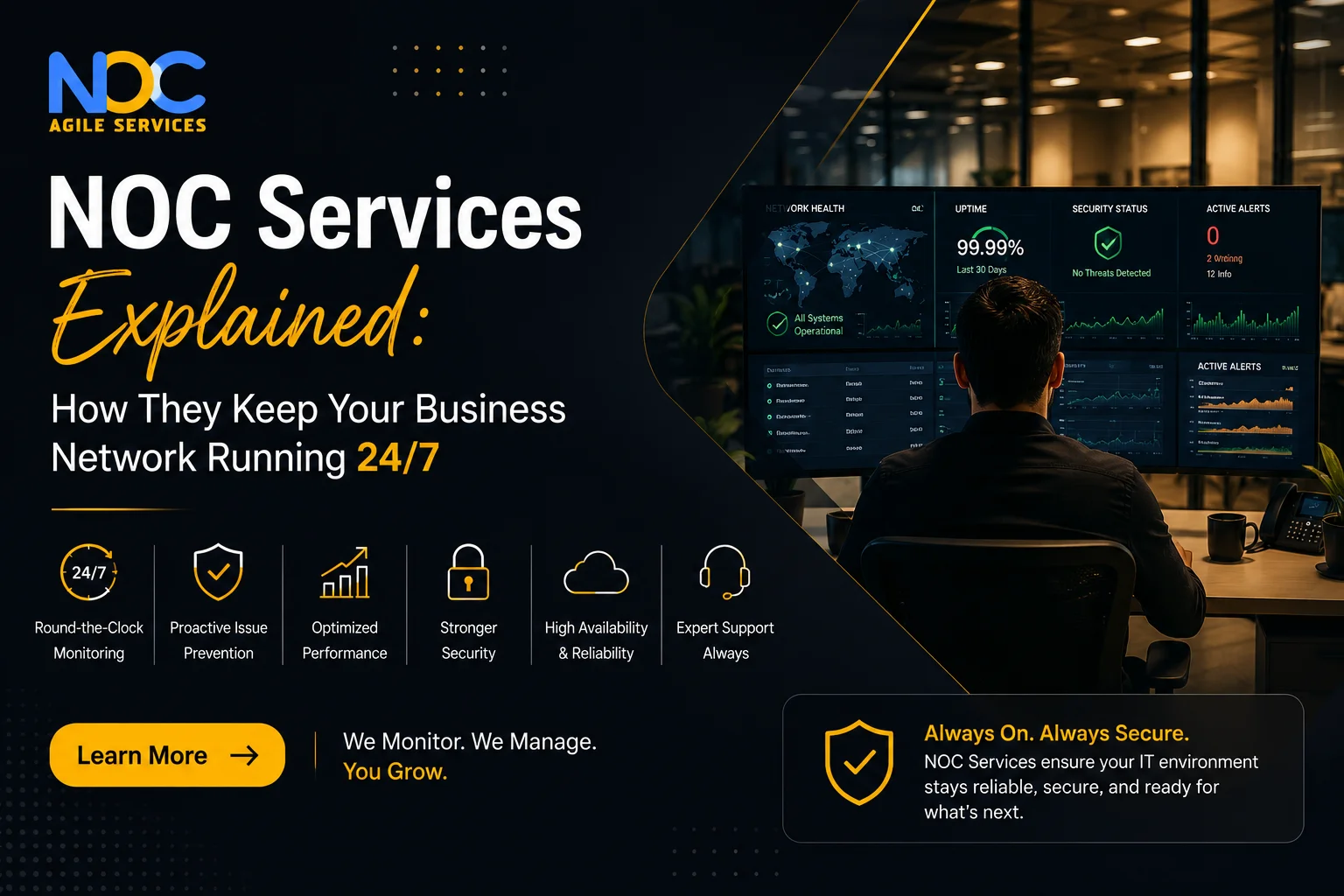
Every business depends on its network staying up — email, cloud apps, customer portals, internal systems. The moment that network stutters, work stops. This is the exact problem NOC services are designed to solve, and understanding how they work can help you decide if your business needs them.
Curious where your network’s blind spots are? Request a free network health check and get a clear picture before something breaks.
What Do These Services Actually Include?
NOC stands for Network Operations Center — a centralized team responsible for monitoring, managing, and maintaining an organization’s network infrastructure. These services cover the continuous oversight needed to keep servers, routers, firewalls, and connections running smoothly, around the clock.
In practice, this typically includes:
- Real-time monitoring of uptime, performance, and traffic patterns
- Incident detection and response before issues become outages
- Proactive maintenance, including patching and capacity planning
- Alert management and escalation so the right person is notified immediately
- Performance reporting that gives you ongoing visibility into network health
You can see the full scope of this on our NOC Services page, which also connects closely with our Managed NOC Services for businesses that want this handled entirely by an outside team.
Why Businesses Rely on This Kind of Network Monitoring
1. Downtime is expensive. Every minute your network is down can mean lost sales, missed deadlines, and frustrated customers. Continuous monitoring catches problems before they escalate into outages.
2. Networks are more complex than ever. Between cloud workloads, remote teams, and growing device counts, manually keeping track of network health isn’t realistic anymore. Dedicated monitoring tools and teams fill that gap.
3. Compliance and reliability expectations are rising. Many industries now expect documented uptime, incident response times, and reporting — something ad hoc IT support struggles to provide consistently.
4. Small issues compound quickly. A single overlooked alert — a failing drive, a saturated link, an unpatched device — can snowball into a major outage. Continuous oversight stops that chain reaction early.
How This Type of Network Monitoring Works, Step by Step
- Baseline setup — the team maps your network and establishes what normal performance looks like.
- Continuous monitoring — automated tools and engineers track uptime, traffic, and device health in real time.
- Detection — any deviation from baseline triggers an alert immediately.
- Triage — engineers assess severity and either resolve the issue directly or escalate per your SLA.
- Resolution — the problem is fixed and documented, with root-cause analysis to prevent recurrence.
- Reporting — you receive regular insight into uptime, incidents, and trends over time.
This cycle runs continuously, which is why well-run network monitoring programs are built around prevention rather than reaction.
In-House Monitoring vs. Outsourcing This Function
| In-House Monitoring | Outsourced Monitoring | |
| Coverage | Often limited to business hours | True 24/7/365 |
| Setup time | Weeks to months | Days to a few weeks |
| Cost | Fixed salaries and tooling | Scales with infrastructure size |
| Expertise | Limited to internal hires | Specialized team on demand |
| Response speed | Depends on staff availability | Continuous, dedicated focus |
NOC vs. Other Related IT Functions
It’s easy to confuse this function with other IT functions, so here’s a quick distinction:
- Network operations monitoring focuses on network performance and uptime
- SOC services focus on security threat detection and response
- Helpdesk services focus on direct support for end users
- Managed IT services is the broader umbrella that can include all of the above
Many businesses combine two or more of these for complete coverage rather than relying on a single function alone.
Does Your Business Need This Kind of Monitoring?
You’re likely a good fit if:
- Downtime has previously cost you revenue, deadlines, or customer trust
- Your IT team is reactive rather than proactive
- Your infrastructure has grown faster than your internal monitoring capability
- You need documented uptime and incident reporting for compliance or client requirements
Frequently Asked Questions
What’s typically included in this kind of network monitoring? Most providers include 24/7 monitoring, incident detection and response, proactive maintenance, alert escalation, and regular performance reporting — though scope can vary by provider and SLA.
Is this kind of monitoring only for large enterprises? No. Small and mid-sized businesses often benefit the most, since they rarely have the resources to staff round-the-clock monitoring internally.
Does this type of service include cybersecurity monitoring? Not typically on their own — that’s the role of SOC services. Many businesses run both together for full network and security coverage.
How quickly do NOC teams respond to issues? Response times depend on the SLA you agree to, but most providers offer tiered response windows based on severity, with the fastest tiers reserved for critical, business-impacting issues.
Final Thoughts
This kind of network monitoring has become a foundational part of keeping modern businesses online, not just a nice-to-have. Whether handled in-house or outsourced, the goal is the same: catching problems before your customers ever notice them.
Keep Your Network Running, Not Just Recovering
NOCAgile delivers 24/7 network monitoring and management built to catch issues before they turn into downtime.
✅ Round-the-clock monitoring and incident response ✅ Transparent SLAs and reporting ✅ 15+ years of network operations experience ✅ Scales with your infrastructure as you grow
Request a Free Network Assessment and see where your current setup has gaps — or explore our full Services lineup, including Managed NOC Services, SOC, Cloud, and Helpdesk support.


