Most businesses treat network monitoring and IT management as two separate problems, hiring different vendors or staff for each one. But the companies that scale smoothly tend to do the opposite — they combine NOC services & managed IT solutions under one strategy, so nothing falls through the cracks between teams.
Wondering if your IT and network monitoring are actually working together? Get a free infrastructure review and see where the gaps are.
What’s the Difference Between the Two?
Before combining them, it helps to understand what each one covers on its own.
NOC Services focus specifically on your network: continuous uptime monitoring, incident detection, proactive maintenance, and performance reporting. The goal is to keep your network running and catch problems before they cause downtime.
Managed IT Services, on the other hand, are the broader umbrella — covering infrastructure management, device support, software updates, security oversight, and day-to-day IT operations across your business. NOC monitoring is one important piece of that larger picture, not a replacement for it.
When businesses talk about combining network monitoring with broader IT management, they’re really describing a combined approach: dedicated network monitoring paired with broader IT management, working from the same playbook instead of operating in silos.
Why Pairing Them Makes Sense
1. Fewer blind spots. When network monitoring and IT management run through separate vendors, issues can fall into the gap between them — a server problem nobody owns, or an update that breaks something the NOC wasn’t tracking. A combined approach closes that gap.
2. Faster root-cause resolution. When the team monitoring your network has full visibility into your broader IT environment, they can connect the dots faster instead of escalating between vendors who don’t talk to each other.
3. Simplified vendor management. Instead of juggling separate contracts, support lines, and SLAs for network monitoring and IT support, one combined relationship means one point of accountability.
4. Better long-term planning. A provider managing both your network operations and your broader IT strategy can plan capacity, upgrades, and security improvements holistically — instead of reacting to issues one silo at a time.
5. Cost efficiency at scale. Bundling network monitoring with managed IT support is often more cost-effective than paying separately for overlapping tools, dashboards, and support contracts.
What a Combined Approach Typically Looks Like
A business running this kind of combined setup usually has access to:
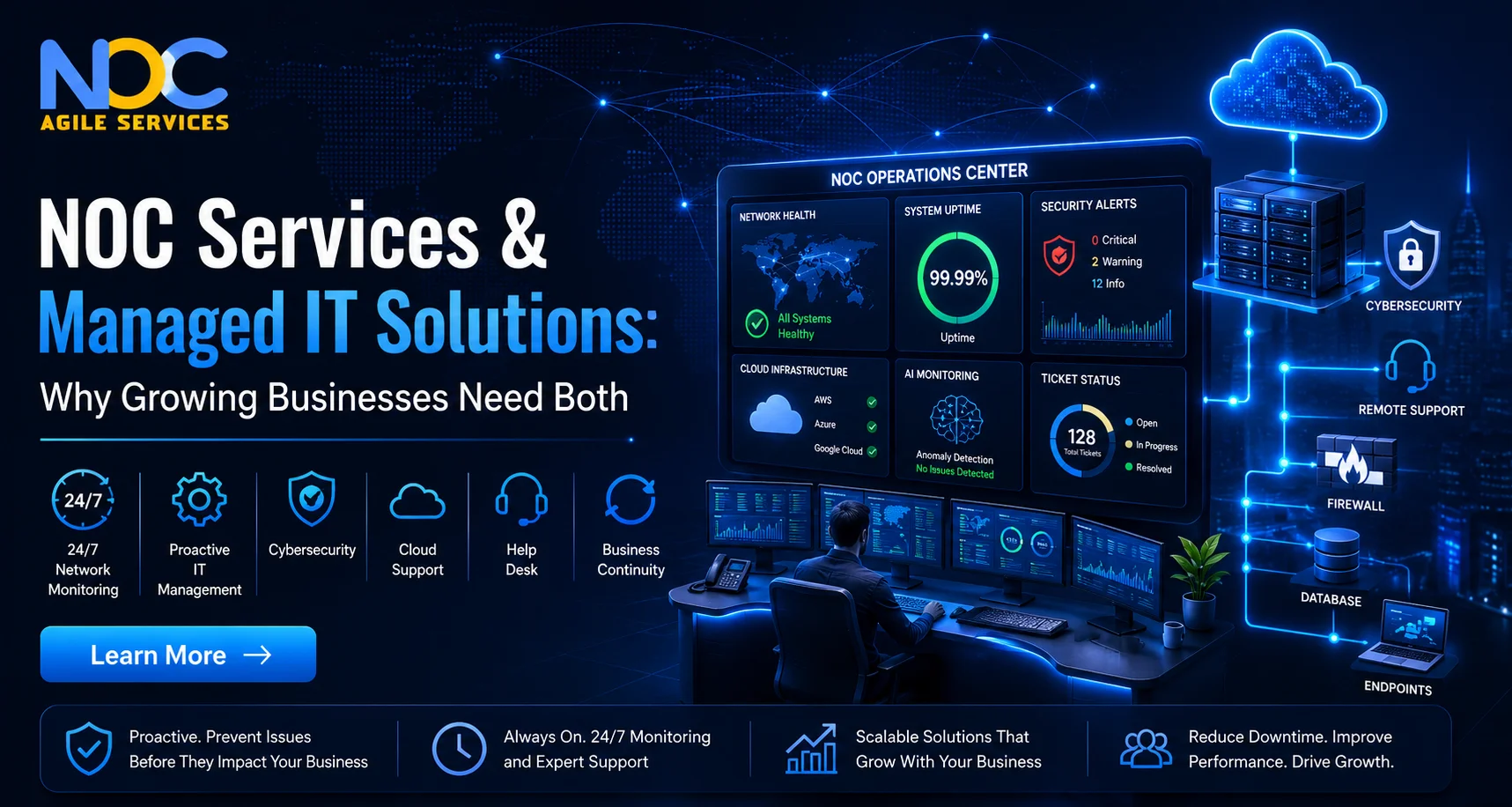
- 24/7 network monitoring and incident response (NOC Services / Managed NOC Services)
- Broader infrastructure and device management (Managed IT Services)
- Security monitoring and threat response (SOC Services)
- End-user support for day-to-day issues (Helpdesk Services)
- Cloud infrastructure management (Cloud Services)
Rather than stitching these together from multiple vendors, having them under one provider means consistent reporting, shared context, and faster response when something goes wrong.
Separate Vendors vs. a Combined Provider
| Separate Vendors | Combined Provider | |
| Visibility | Fragmented across tools/teams | Unified across network and IT |
| Response time | Slower — requires cross-vendor coordination | Faster — single team, shared context |
| Accountability | Unclear when issues span both areas | One point of contact |
| Cost | Overlapping tools and contracts | Often more cost-efficient at scale |
| Planning | Reactive, siloed | Proactive, holistic |
Is a Combined Approach Right for Your Business?
This pairing tends to make the most sense if:
- You’re currently using separate vendors for network monitoring and IT support
- Issues have been “falling through the cracks” between teams in the past
- You’re scaling infrastructure and want a single strategy instead of patchwork support
- You want consolidated reporting instead of checking multiple dashboards
Frequently Asked Questions
Do I need both NOC services and managed IT solutions, or just one? It depends on your current setup. If you already have solid internal IT support but lack 24/7 network monitoring, NOC services alone may close the gap. If you’re missing both, a combined approach is usually more efficient than building two separate relationships.
Is combining network monitoring with managed IT support more expensive than handling them separately? Usually the opposite — bundling tends to reduce overlapping tools, redundant contracts, and the inefficiency of cross-vendor coordination.
Can I start with just NOC services and add managed IT later? Yes. Many businesses start with network monitoring and expand into broader managed IT services as their infrastructure and support needs grow.
Does this combined approach also include security monitoring? Security is typically handled through SOC services, which can run alongside this combined approach for full coverage — network, infrastructure, and security all in one strategy.
Final Thoughts
Treating network monitoring and IT management as two disconnected functions often creates the exact gaps that lead to downtime and slow resolution. Combining the two under one strategy gives growing businesses the visibility, speed, and accountability that fragmented vendor relationships usually can’t match.
One Strategy. Full Coverage. No Gaps.
NOCAgile combines 24/7 network monitoring with broader managed IT support, so your infrastructure is covered end to end.
✅ Unified NOC and IT management under one team
✅ Transparent SLAs and consolidated reporting
✅ 15+ years of network and IT operations experience
✅ Scales as your infrastructure grows
Get a Free Infrastructure Review and see how a combined approach can close the gaps in your current setup — or explore our full Services lineup, including NOC, Managed IT, SOC, Cloud, and Helpdesk support.


