Most businesses don’t discover network problems when monitoring software detects them.
They discover them when somebody complains.
A customer says the portal is slow. Employees cannot reach a cloud application. VoIP calls start dropping. A remote office loses connectivity. An important application suddenly stops responding.
By then, the technical problem has already become a business problem.
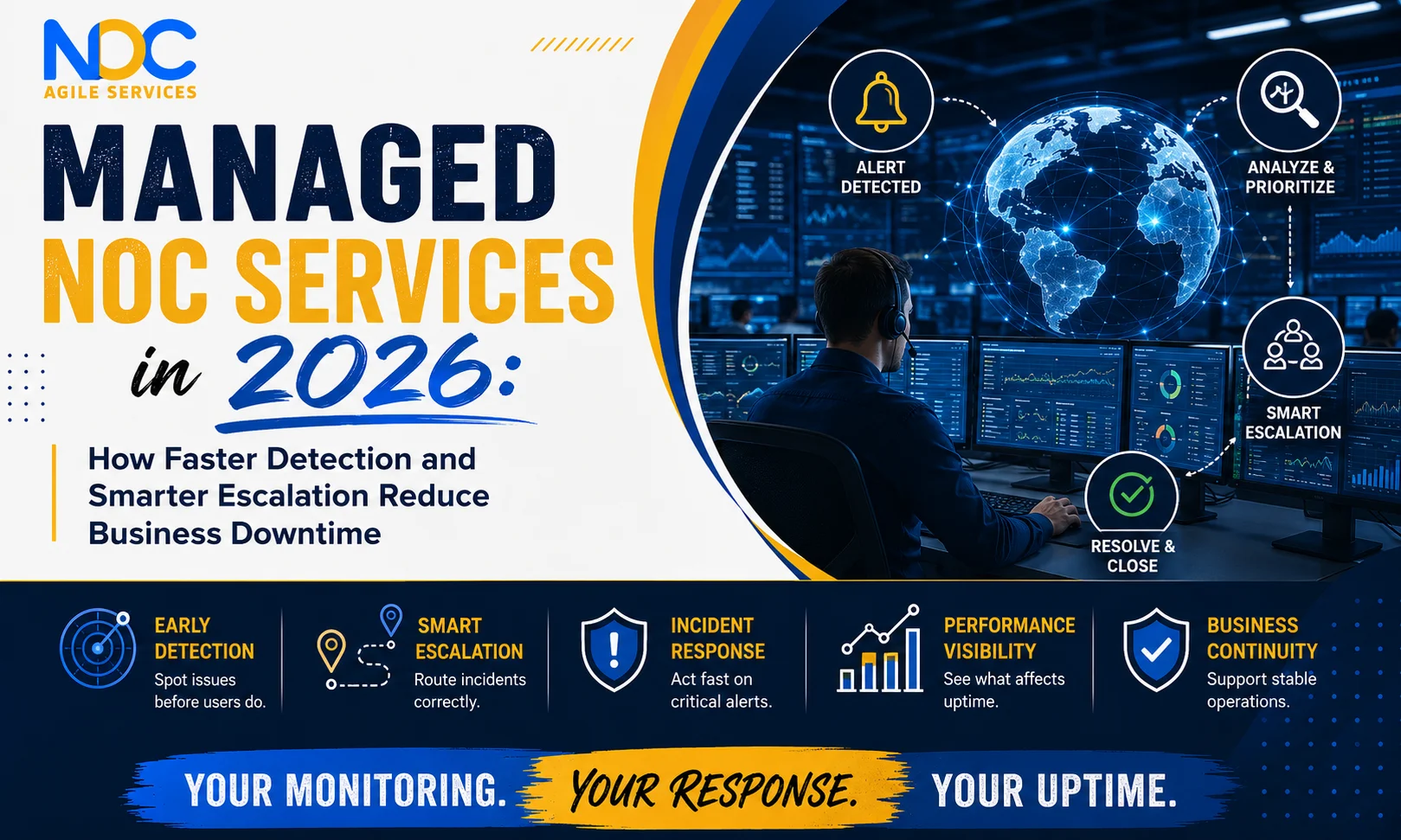
Modern Managed NOC Services are designed to change that sequence. Instead of waiting for users to notice that something is wrong, a Network Operations Center continuously watches infrastructure, identifies abnormal behavior, separates meaningful incidents from routine noise, and gets the right problem in front of the right engineer.
The value is not simply “24/7 monitoring.”
The real value is reducing the time between something beginning to fail and somebody taking useful action.
The Downtime Clock Starts Before Your Users Notice
Infrastructure problems rarely begin with a dramatic outage.
A server may slowly consume available memory.
Storage utilization may climb from 70% to 85% and then 95%.
Packet loss may increase gradually.
A WAN connection may become unstable.
An application may continue operating while response times quietly deteriorate.
Without proactive network monitoring, these warning signs can remain unnoticed until service quality becomes unacceptable.
This is where Managed NOC Services create operational value.
A mature NOC watches health and performance indicators continuously so teams can investigate developing problems before every issue becomes an emergency.
The earlier a meaningful problem is detected, the more options engineers usually have for resolving it with less disruption.
Monitoring More Does Not Automatically Mean Monitoring Better
Organizations today can collect enormous amounts of infrastructure data.
CPU utilization. Memory. Disk capacity. Latency. Packet loss. Interface status. Application availability. Cloud utilization. Device health. Event logs. Errors. Traffic patterns.
The problem is no longer a lack of information.
The problem is deciding which information deserves action.
Poorly configured monitoring systems can produce hundreds or thousands of alerts, many of which are repetitive, temporary, or operationally insignificant.
When everything creates an alert, alerts eventually become background noise.
Google’s Site Reliability Engineering guidance makes an important point about monitoring: alerts should be actionable. If an alert cannot reasonably result in action from the person receiving it, it creates noise rather than useful operational awareness.
That principle applies directly to NOC monitoring services.
A good NOC does not exist to generate the largest number of alerts.
It exists to identify the alerts that matter.
From Alert to Action: What a Managed NOC Should Actually Do
Imagine a critical server suddenly reaches 98% disk utilization.
Basic monitoring might send an email.
That isn’t incident management. It is notification.
Effective Managed NOC Services should follow a structured workflow.
1. Detect
Monitoring systems identify behavior outside established thresholds or expected performance.
2. Validate
The NOC determines whether the event represents a genuine problem, a temporary condition, planned maintenance, or a false positive.
3. Prioritize
The incident is classified according to severity, affected systems, business impact, and urgency.
4. Investigate
Engineers examine available metrics, logs, configuration information, dependencies, and recent changes.
5. Remediate or Escalate
If the issue falls within an approved procedure, the NOC takes corrective action.
If specialist involvement is required, the issue is escalated with useful diagnostic context.
6. Document
Actions, findings, timelines, and outcomes are recorded.
7. Review
Recurring incidents can then be analyzed to determine whether a permanent technical change is required.
That complete cycle is considerably more valuable than receiving another email stating that a server is unavailable.
Why MTTR Is Such an Important NOC Metric
One useful way to evaluate operational performance is Mean Time to Repair or Restore (MTTR).
In practical terms, it asks:
Once something goes wrong, how long does it take to restore normal service?
Google’s Site Reliability Engineering guidance also highlights MTTR as a particularly relevant measure of emergency response effectiveness.
Consider two businesses experiencing exactly the same infrastructure failure.
Company A discovers the issue 25 minutes later, spends another 20 minutes identifying the responsible engineer, and then begins troubleshooting.
Company B has 24/7 NOC monitoring, detects the issue quickly, validates it, follows a documented runbook, and immediately escalates it to the correct technical resource when necessary.
The technical failure may be identical.
The operational outcome can be very different.
This is why Managed NOC Services should be judged on response quality rather than simply the number of systems being monitored.
Smarter Escalation Can Save Valuable Minutes
Escalation sounds simple until an actual incident occurs.
Who should receive a critical firewall alert at 2:15 AM?
What happens if that person does not respond?
When should a Level 1 engineer escalate to Level 2?
Which incidents can the NOC resolve without authorization?
Which systems require immediate customer notification?
A mature managed NOC service provider should answer these questions before an incident happens.
Clear escalation matrices can define:
- Incident severity levels
- Response expectations
- Technical ownership
- Communication procedures
- Escalation timelines
- Authorized remediation actions
- Backup contacts
- SLA requirements
During a serious outage, nobody should be discovering the escalation process for the first time.
Runbooks Turn Experience Into Repeatable Action
Experienced engineers are important.
Repeatable processes are equally important.
A runbook documents the actions engineers should take when specific operational events occur.
For example, a high disk utilization runbook might specify how to verify the alert, what logs to inspect, which temporary files can safely be removed, when capacity should be expanded, and when escalation is mandatory.
Runbooks help Network Operations Center Services respond consistently instead of depending entirely on whoever happens to be working when an incident occurs.
They also help preserve operational knowledge.
When troubleshooting knowledge lives only inside one senior engineer’s head, that engineer becomes a bottleneck.
When proven procedures are documented, the wider operations team becomes more effective.
What Should Managed NOC Services Monitor?
The answer depends on the environment, but modern infrastructure monitoring commonly extends beyond traditional routers and switches.
A comprehensive approach may include:
- Servers and virtual machines
- Routers and switches
- Firewalls
- WAN and internet connections
- Cloud infrastructure
- Applications and services
- Storage capacity
- CPU and memory utilization
- Network latency and packet loss
- Device availability
- Backup status
- Infrastructure performance trends
NOCAGILE’s own NOC capabilities include round-the-clock monitoring, incident management, proactive maintenance, alert management, server and infrastructure monitoring, SLA-based escalation, and support for hybrid and cloud infrastructure.
The objective is visibility across the infrastructure that your business actually depends on—not simply monitoring individual devices in isolation.
When Does a Business Need Managed NOC Services?
There is no magic number of employees, servers, or locations.
Instead, look at operational symptoms.
Managed NOC Services may be worth considering when:
Your customers detect problems before your IT team does.
Your internal engineers are overwhelmed by monitoring alerts.
Nobody is consistently watching infrastructure overnight.
Critical incidents regularly depend on one or two senior employees.
Network problems repeatedly return without root-cause follow-up.
Your business has expanded into multiple offices, cloud environments, or locations.
Your team struggles to maintain clear SLA response expectations.
Infrastructure is growing faster than IT operations headcount.
These are indicators that monitoring needs to become a structured operational function.
How NOCAGILE Approaches Managed NOC Services
At NOCAGILE, network operations are not treated as a dashboard-watching exercise.
With 15+ years of network operations experience, our approach combines continuous infrastructure visibility with structured incident management, escalation, troubleshooting, proactive maintenance, and performance monitoring.
NOCAGILE supports businesses, MSPs, IT companies, healthcare organizations, financial services, e-commerce businesses, enterprises, and data-center environments with scalable NOC capabilities.
Our Managed NOC Services can work as an extension of an existing IT department or provide organizations with dedicated operational coverage when building a complete internal Network Operations Center is not practical.
The focus is straightforward:
detect earlier, respond intelligently, escalate clearly, and keep infrastructure available.
Good Monitoring Should Create Fewer Surprises
Businesses will never eliminate every IT failure.
Hardware fails. Applications develop problems. Connections drop. Cloud services experience disruptions. Configurations change. Unexpected traffic appears.
The objective of a good NOC is not to promise that nothing will ever go wrong.
It is to make sure that when something does go wrong, your organization sees it quickly and has a structured way to respond.
That is the practical value of Managed NOC Services.
Better visibility.
Less alert noise.
Faster escalation.
More consistent incident response.
And fewer occasions where your customers become your monitoring system.
If your organization is still relying on business-hour monitoring, unmanaged alerts, or reactive troubleshooting, NOCAGILE can help evaluate where your current monitoring and escalation processes may have gaps.
Talk to NOCAGILE about building a 24/7 managed NOC model around your infrastructure, SLAs, and business requirements.
Frequently Asked Questions
1. What are Managed NOC Services?
Managed NOC Services provide continuous infrastructure monitoring, incident detection, troubleshooting, escalation, reporting, and proactive network management through a dedicated NOC team.
2. What is 24/7 NOC monitoring?
24/7 NOC monitoring means critical infrastructure is continuously monitored during business hours, nights, weekends, and holidays.
3. What does a managed NOC service provider monitor?
A managed NOC service provider can monitor servers, routers, switches, firewalls, cloud infrastructure, applications, connectivity, capacity, and network performance.
4. How can Managed NOC Services reduce downtime?
They can identify infrastructure problems earlier, prioritize incidents, follow predefined procedures, and escalate issues quickly to appropriate engineers.
5. What is MTTR in NOC services?
MTTR generally measures how quickly an organization restores normal service after an incident and is useful for evaluating incident-response efficiency.
6. What is proactive network monitoring?
Proactive network monitoring continuously tracks infrastructure health and performance to identify developing problems before they become serious outages.
7. What is NOC incident management?
NOC incident management covers detection, validation, prioritization, troubleshooting, remediation, escalation, documentation, and follow-up of infrastructure incidents.
8. What is the difference between NOC monitoring and basic alerting?
Basic alerting sends notifications. NOC monitoring services add human validation, prioritization, troubleshooting, escalation, and operational response.
9. Can Managed NOC Services support cloud infrastructure?
Yes. Modern Managed NOC Services can monitor on-premises, cloud, and hybrid infrastructure depending on the provider’s capabilities and monitoring tools.
10. How do I choose a Managed NOC Service Provider?
Look for true 24/7 coverage, experienced engineers, clear SLAs, documented escalation, actionable reporting, monitoring-tool compatibility, runbooks, and scalable support options.


